Back to blog
WooCommerce vs. Wix: Which One Is a Better Website Builder?
Compare WooCommerce vs Wix and learn how you can choose the right platform for your store based on ease of use, flexibility, and growth needs.

Apr 1 2026
WooCommerce and Wix are created for different purposes, and choosing between them depends on what your business actually needs from a website. WooCommerce powers roughly 33% of all tracked e-commerce stores globally, while Wix Stores holds about 11% of that same market.
This guide covers what each tool does well, where each one falls short, and what to consider before committing to either.
Key Takeaways
- WooCommerce is a WordPress plugin, not a standalone website builder, which means that setup requires a hosting account, a domain, and familiarity with WordPress
- Wix is a closed platform, meaning design flexibility and data portability are limited compared to self-hosted solutions
- Neither tool is the fastest or simplest path to a professional website, especially for business owners who want to get online without a steep learning curve
- The right choice depends on whether you need deep e-commerce customization, a beginner-friendly editor, or something that gets a polished site live without technical setup
WooCommerce Overview
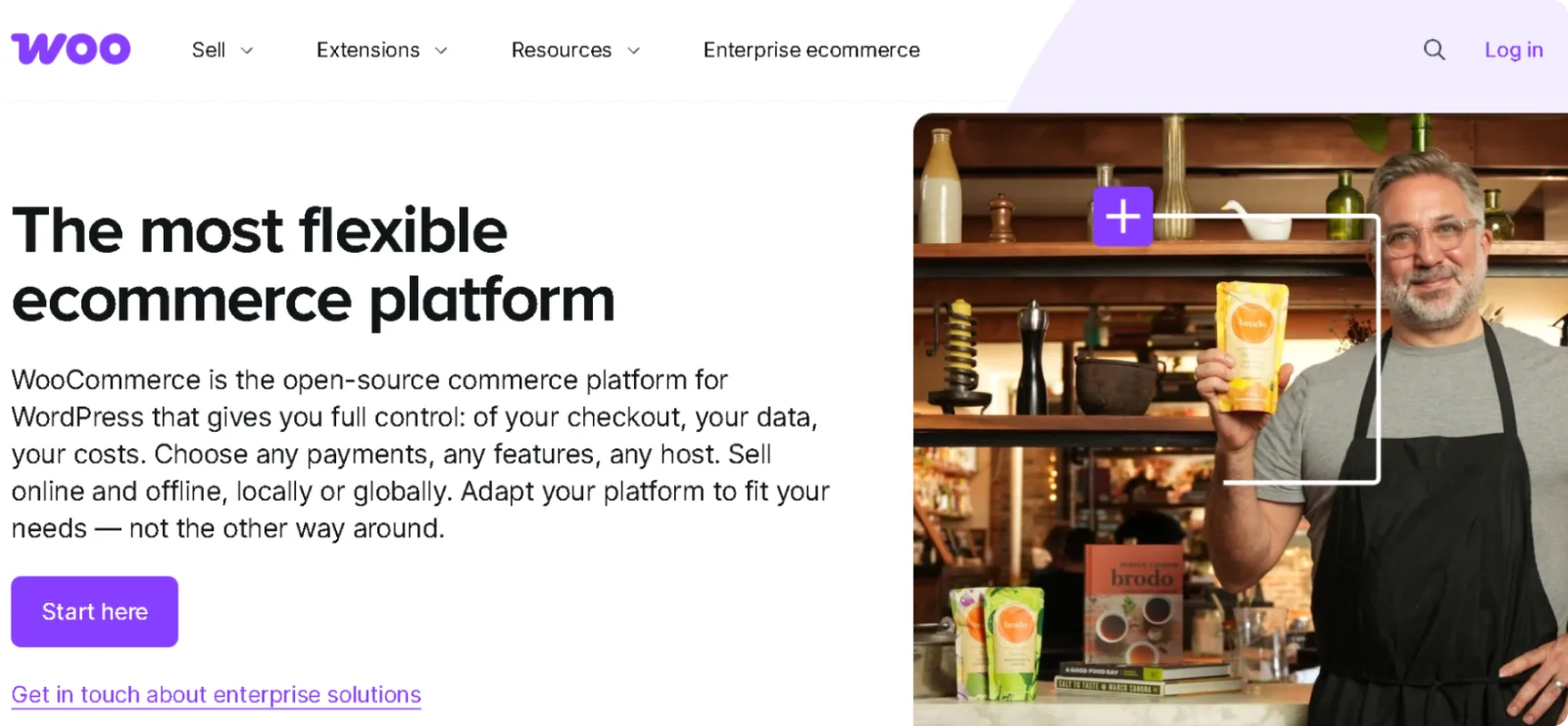
WooCommerce is a free, open-source e-commerce plugin for WordPress that turns any WordPress site into a fully functional online store. It targets developers, agencies, and established businesses that need deep customization over their store's checkout, data, and product architecture.
WooCommerce Key Features
- Open-source architecture: Gives full access to source code, allowing developers to modify every aspect of the store without platform restrictions
- Plugin ecosystem: Extends functionality through thousands of free and premium extensions covering shipping, payments, subscriptions, and marketing
- WooPayments: Processes payments natively through Stripe integration, supporting major cards and local payment methods without a third-party gateway
- Headless commerce support: Allows developers to decouple the frontend from the backend, serving store data through APIs to any custom interface
- Unlimited products: Supports unrestricted product listings, variants, and categories with no platform-imposed ceiling
Wix Overview
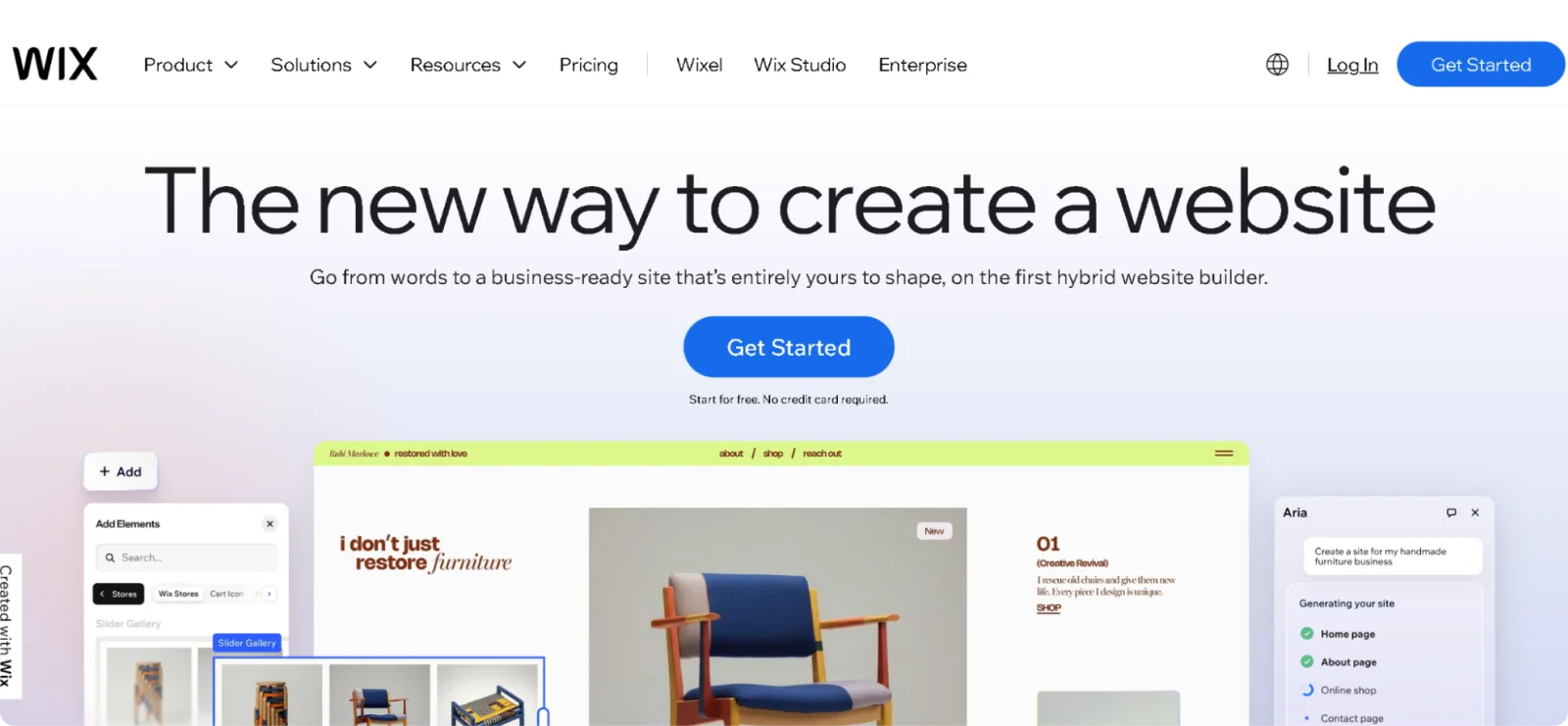
Wix is a cloud-based website builder that combines a drag-and-drop editor with AI-powered site generation, built-in e-commerce, and an extensive app marketplace. It targets small businesses, entrepreneurs, and non-technical users who want a professional site without having to manage hosting, plugins, or technical maintenance.
Wix Key Features
- Wix ADI and AI Site Generator: Generates a complete website from a short questionnaire and lets users switch between AI-assisted and manual editing at any point
- Wix App Market: Extends functionality through 800+ third-party applications covering bookings, dropshipping, live chat, and marketing automation
- Wix Stores: Supports up to 50,000 products with inventory management, multiple payment gateways, abandoned cart recovery, and subscription selling on paid plans
- Wix SEO Suite: Manages meta titles, descriptions, sitemaps, and structured data from a single dashboard with an AI-assisted optimization checklist
- Built-in hosting and security: Includes SSL certificates, automatic backups, and CDN delivery on all plans with no separate infrastructure to manage
WooCommerce vs. Wix: Head-to-Head Comparison
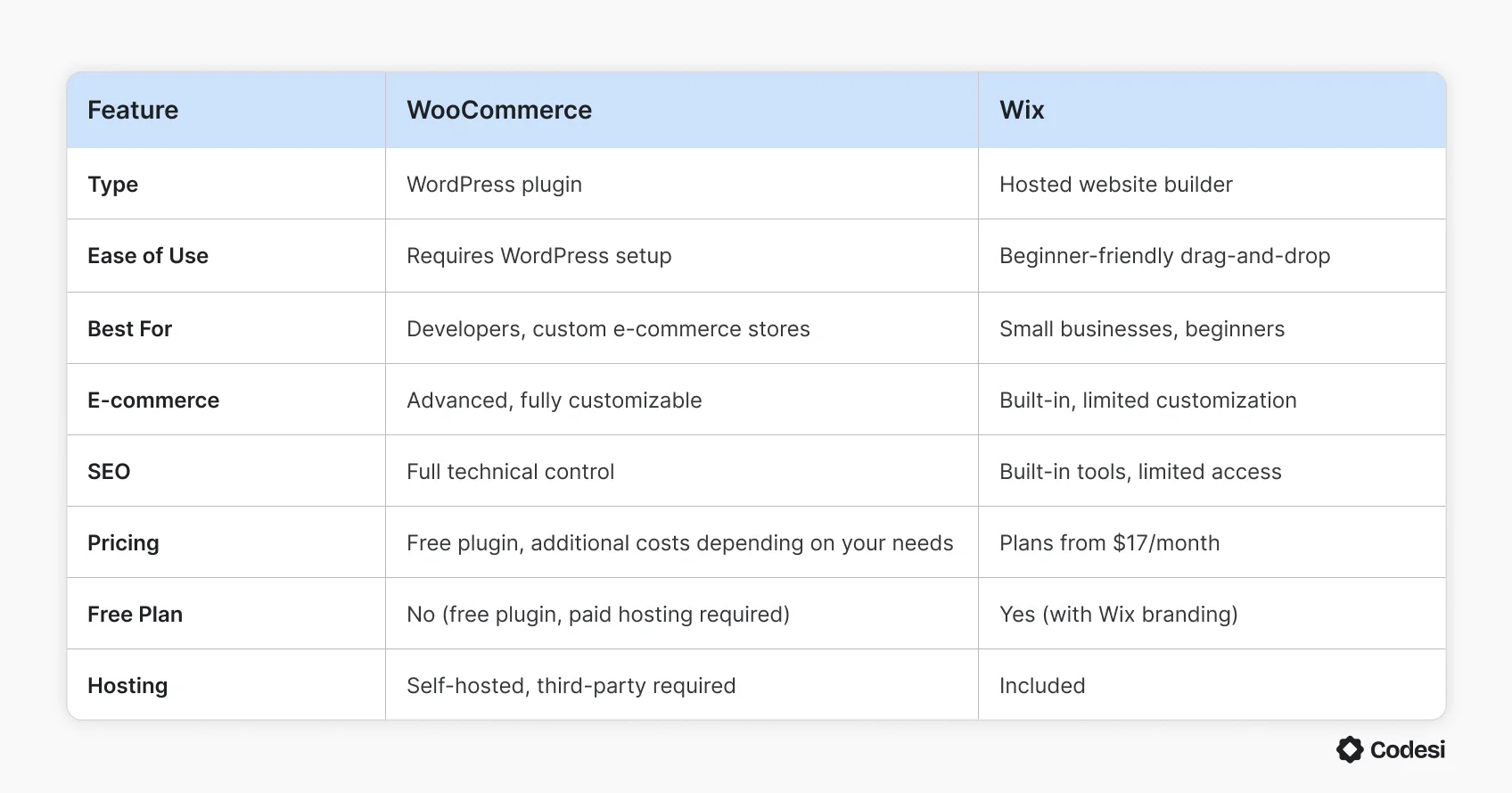
The table below covers the key differences before getting into the details.
Ease of Use
WooCommerce has a setup process that most people underestimate until they are halfway through it. Before building a single page, you need a WordPress installation, a hosting account, a domain, and the WooCommerce plugin configured correctly. Advanced modifications require technical expertise or a developer, making the configuration challenging.
Wix takes the opposite approach. The drag-and-drop editor lets anyone build and launch a complete site without coding, with live changes visible in real time. Mobile performance occasionally lags on content-heavy pages, but the overall experience is significantly smoother for non-technical users.
Verdict: Wix wins on ease of use. WooCommerce rewards technical investment but requires knowledge upfront.
Design Flexibility
WooCommerce runs on WordPress, giving it access to thousands of free and premium themes. Design possibilities are essentially unlimited, but they require either coding skills or a budget for someone who has them. Premium themes also cost extra.
Wix offers over 2,000 customizable templates, all with a drag-and-drop editor. The tradeoff is that switching templates after going live means rebuilding the site from scratch, a limitation that may catch users off guard after they have already invested time building their pages.
Verdict: WooCommerce has a higher design ceiling. Wix is more accessible but less flexible in the long term, particularly for businesses whose visual identity evolves over time.
E-commerce Features
WooCommerce supports unlimited products, multi-currency, subscriptions, memberships, and an ecosystem of thousands of plugins. It handles complex e-commerce logic well. However, many of the features that make it powerful, such as advanced shipping rules, abandoned cart recovery, and multi-language support, require paid extensions in addition to the base plugin.
Wix supports up to 50,000 products and covers the essentials: product listings, payment gateways, inventory management, and order fulfillment. For a small store selling a focused range of products, it handles everything without configuration overhead. For a store with complex inventory, variable pricing, or B2B requirements, it is more restrictive than WooCommerce.
Verdict: WooCommerce wins for complex e-commerce needs. Wix is sufficient for straightforward stores but falls short as product complexity grows.
SEO Capabilities
WooCommerce inherits WordPress's SEO architecture, giving it a significant edge for businesses where organic search is a primary growth channel. Plugins like Yoast SEO and Rank Math provide granular control over sitemaps, schema markup, canonical URLs, and redirects. None of that requires developer involvement once configured, and users consistently note better visibility optimization compared to closed platforms.
Wix has improved significantly in this area. Built-in tools cover page titles, meta descriptions, image alt text, and indexing. The SEO Wiz generates a personalized plan based on your site and business type, which is useful for beginners. That said, multilingual SEO is not particularly clean, and mobile load speeds on content-heavy pages can drag down search performance.
Verdict: WooCommerce wins for SEO, particularly for competitive keywords and content-heavy sites. Wix covers the basics well but may not be suitable for businesses where search visibility is a priority.
Pricing and Value
WooCommerce's plugin is free, but the real cost adds up quickly. You need WordPress hosting, a domain, a premium theme, and likely several paid extensions. Average costs depend on functionality and site complexity, which makes upfront budgeting difficult.
Wix offers predictable monthly costs, with everything included. Plans start at $17/month for a basic site, with e-commerce from the Core plan at $29/month. There are no surprise hosting bills or plugin fees. The tradeoff is that you pay for features you may not use, and there is no way to reduce costs by stripping the platform back.
Verdict: Wix wins on pricing predictability. WooCommerce can be cheaper at scale for technically capable teams, but the cost structure is harder to forecast.
Customer Support
WooCommerce does not offer dedicated support in the traditional sense. The platform relies on documentation, community forums, and third-party developers to resolve issues. That works well if you are comfortable troubleshooting independently. It falls short when something breaks before a product launch, and you need a fast answer.
Wix provides 24/7 callback support for English speakers, live chat during business hours, and a help center with video tutorials and Wix Academy. Response quality varies by issue complexity, and some users report longer wait times for technical problems. The support infrastructure is still significantly more accessible than WooCommerce's community-dependent model.
Verdict: Wix wins on accessibility support. WooCommerce's community is large and knowledgeable, but it is not a substitute for structured support when time matters.
Scalability
WooCommerce scales as far as your hosting and development budget allow. Its open-source nature lets you modify or extend functionality as the business grows, with no platform-imposed limit on products, traffic, or features.
Wix does not handle large catalogs or high traffic as efficiently. Site navigation is limited to one sub-level, making large product catalogs cumbersome to organize. Multi-currency selling is not natively supported, and Wix-built sites tend to load more slowly than sites on other platforms, particularly on mobile.
Verdict: WooCommerce wins on scalability. Wix is practical for small stores, but businesses planning meaningful growth will hit platform limits before long.
WooCommerce vs. Wix: Which One Should You Choose?
Neither tool is a universal winner. The right pick depends on your technical comfort level, store complexity, and how much work you are willing to do before the first page goes live.
Choose WooCommerce if:
- You already run a WordPress site and want to add e-commerce without migrating to a new platform
- You need full ownership of customer data, order history, and store infrastructure
- You sell products requiring complex configuration, such as subscriptions, variable pricing, or B2B wholesale
- You have a developer on the team or budget to hire one for setup and ongoing maintenance
- You want unlimited customization over checkout flow, product pages, and shipping logic
- You plan to scale into a high-volume store where hosting flexibility and plugin control matter long term
Choose Wix if:
- You need a professional site live fast without technical setup or a developer
- You run a small store selling a focused range of products with straightforward inventory
- You want booking, email marketing, and social media management handled from one dashboard
- You have no prior web design experience and need a guided, beginner-friendly build process
- You operate a service business where the website primarily captures leads rather than processing high-volume transactions
- You prefer predictable monthly costs over a variable self-hosted expense structure
In short, WooCommerce gives you full control but requires technical knowledge, ongoing maintenance, and a hosting budget before you can actually build something.
Wix removes that friction entirely. Setup is fast, the editor is intuitive, and the platform handles hosting, security, and updates automatically. The tradeoff is that you are building inside a closed system with limits that become harder to ignore as the business grows.
If your needs fall somewhere in the middle, which is where most small businesses actually land, Codesi is an option worth considering.
Why Codesi Is the Best Alternative to WooCommerce and Wix
Most business owners searching for a website builder are not looking for a project. They want something professional fast, without a setup process that stretches across a weekend or a learning curve that requires YouTube tutorials to navigate.
This is where Codesi comes into play. Describe your business, choose a style, and the platform generates a complete, branded website in under three minutes. The result is a structured, ready-to-publish site built around your specific input.
What the first generation includes:
- Complete site generation: Produces a fully structured website with copy, images, and contact forms from a single text description
- AI logo and image creation: Generates custom brand visuals matched to your business context without stock photo subscriptions or separate design tools
- Built-in SEO structure: Configures on-page SEO, mobile optimization, and site speed automatically before the first publish
- Live visual editing: Lets you modify text, swap images, and rearrange sections directly on the page without touching code
- Custom domain connection: Links a new or custom domain with SSL included, directly from the dashboard
Start Codesi for free and see what it generates in minutes.
FAQ
Is Wix better than WooCommerce?
For simple sites and small stores, yes. Wix gets a professional site live faster, requires no technical setup, and handles hosting automatically. WooCommerce is the stronger choice for complex e-commerce stores that need custom checkout flows, unlimited product variants, and full data ownership.
Can I use WooCommerce with Wix?
No. WooCommerce is a WordPress plugin and only works within a WordPress environment. Wix is a closed platform with its own built-in e-commerce tools. The two are not compatible and cannot be combined on the same site.
Create your website with AI today
Codesi is a platform where you can make a website in 3 minutes.
No coding, no designers, no hassle - just AI.