Back to blog
Webflow vs. Framer: Which Is Best in 2026? [Fully Compared]
Compare Webflow vs Framer to see which platform fits your design workflow, needs, and budget so you can build faster and publish with confidence.

Feb 17 2026
![Webflow vs. Framer: Which Is Best in 2026? [Fully Compared]](https://codesi.ai/admin/static/cov07_0960bf06a8.webp)
The website builder market reached $6.2 billion in 2025 and continues to grow as designers abandon traditional development in favor of visual tools. This Webflow vs. Framer comparison helps you choose between two platforms that revolutionized how professionals build websites without writing code.
Both Webflow and Framer target designers and creative professionals, but they approach website building differently.
Webflow functions as a visual development platform with deep customization and enterprise-grade CMS capabilities. Framer positions itself as a design-to-production tool, emphasizing speed, animation, and collaboration.
This guide breaks down Webflow vs Framer across features, pricing, design control, and ease of use. If neither platform fits your needs perfectly, we'll also introduce an alternative that delivers professional websites in minutes.
Webflow Overview

Webflow is a visual development platform for designers, developers, and marketing teams who need professional control over their websites without traditional coding. The platform targets agencies, enterprises, and technical creatives who build client sites or manage complex web projects requiring both design flexibility and content management capabilities.
The Webflow Designer automatically generates production-ready HTML, CSS, and JavaScript as you design visually, creating clean, semantic code without manual programming. This positions Webflow between simple website builders and full development frameworks, appealing to users who want pixel-perfect design control alongside developer-grade output.
Key Features
- Webflow Designer with visual canvas: Create responsive websites through a drag-and-drop interface with real-time preview, CSS grid and flexbox controls, and automatic code generation producing clean HTML/CSS/JavaScript.
- CMS with flexible content structure: Build blogs, portfolios, and dynamic pages with 2,000 to 20,000 CMS items, API access at 60–120 requests per minute, and collection-based content organization.
- GSAP-powered interactions: Design sophisticated timeline-based animations responding to scroll, hover, and click events with native GSAP (GreenSock) integration for motion-rich experiences.
- Webflow AI suite: Generate complete pages, write content variations, create sections from existing design systems, and receive SEO/AEO optimization suggestions directly within the platform.
- Edit Mode for content teams: Allow marketers and editors to update text, images, and links without affecting the design, through a simplified interface that requires no technical knowledge.
- Enterprise-grade hosting: Access automatic image compression, code minification, global CDN delivery, SSL certificates, and real-time caching with guaranteed SLA on Enterprise plans.
Pros
- Generates clean, exportable code allowing migration to other hosting platforms without vendor lock-in
- Provides granular design control, matching the capabilities of hand-coded websites through a visual interface
- Includes native localization supporting multiple languages with translation management, regional URLs, and SEO optimization per locale
- Offers real-time collaboration, allowing multiple team members to work simultaneously with role-based permissions
Cons
- Presents a steep learning curve requiring hours of training for proficiency
- Has a complex pricing structure, combining Site plans and Workspace plans
- Restricts real-time design collaboration to one designer at a time
- Locks advanced features behind expensive Workspace tiers
Pricing
Webflow offers a free plan with limited features and Webflow branding.
Paid Site plans start at $18 per month for Basic ($14 annually), $29 per month for CMS ($23 annually), and $49 per month for Business ($39 annually).
Workspace plans for team collaboration start at $24 per month with 10 staging sites.

Framer Overview

Framer is a canvas-based website builder for designers and creative teams that prioritize visual polish and animation quality over extensive content management. The platform targets agencies, freelancers, and startups building marketing sites, portfolios, and landing pages requiring interactive micro-animations and high-fidelity design execution.
Framer’s interface resembles design tools like Figma, making the learning curve shorter for designers transitioning from prototyping to production. This positions Framer between traditional website builders and design software, appealing to users who want sophisticated motion design without having to learn complex animation libraries.
Key Features
- AI-powered layout generation (Wireframer): Generate complete page structures from text descriptions, including hero sections, features, testimonials, and pricing tables with suggested copy.
- Interactive components with Workshop AI: Create custom reusable components by describing functionality in natural language, generating property controls and micro-interactions automatically.
- Relational CMS with up to 10,000 items: Build dynamic content structures connecting collections through relationships, supporting blogs, portfolios, and product catalogs with API access.
- On-page editing for live updates: Edit published pages directly in the browser without opening the editor, allowing quick content changes and real-time collaboration.
- Advanced analytics with events and funnels: Track user behavior, including scroll depth, click patterns, form interactions, and conversion funnels, on the Scale plan with UTM tracking.
- Free custom domain on yearly plans: Receive a free .com domain for the first year through a partnership with Hover (when upgrading to annual billing).
Pros
- Delivers a design-first approach, matching the quality of hand-crafted prototypes with smooth micro-interactions and scroll animations
- Provides fast setup time, allowing designers to launch marketing sites within hours
- Includes unlimited form submissions across all paid plans without additional charges
Cons
- Charges expensive localization fees at $20 per language, making multilingual sites cost-prohibitive for startups
- Locks staging environments, redirects, and role-based permissions behind the Pro plan
- Limits CMS capabilities
- Restricts advanced analytics, including events, funnels, and extended history, to the Scale plan
Pricing
Framer offers a free plan with limited features and Framer branding.
Paid plans start at:
- $15 per month for Basic ($10 annually) with 30 pages and 1,000 CMS items
- $45 per month for Pro ($30 annually) with staging and 150 pages
- $100 per month for Scale (annual billing only) with advanced analytics and flexible usage-based limits
Enterprise plans offer custom pricing.

Direct Comparison: Webflow vs. Framer
When you’re deciding between Webflow vs. Framer, you’re choosing between technical control with robust content management and design speed with visual creativity.
The table below shows you a quick comparison between the two tools:

Design and Customization
Webflow approaches web design as visual programming. Every change you make maps directly to HTML and CSS structures. You’ll manipulate box models, z-index stacking, and CSS transforms through visual controls while keeping full code accuracy.
Framer treats web design like a canvas illustration. Your layouts flow more intuitively, but with less technical precision beneath the surface. You’ll ship faster but give up some granular code-level control.
Ease of Use and Learning Curve
The key difference comes down to how you think.
Webflow expects you to think like a developer using visual tools. You’ll need to understand web fundamentals, such as document flow and specificity, before you feel fully comfortable with the platform.
Framer expects you to think like a designer using production tools. If you already use Figma or Sketch, you can translate those familiar patterns directly to live websites without learning new conceptual frameworks.
Animation and Interactions
Timeline control separates these platforms clearly.
With Webflow’s GSAP integration, you get frame-accurate sequencing. You can orchestrate multiple elements across complex animation sequences with millisecond precision.
Framer optimizes for preset animation patterns that AI enhances. Instead of building animations from scratch, you describe what you want and refine the AI-generated results. This works faster for common patterns, but it limits you to unique requirements.
CMS and Content Management
The complexity of your content architecture will determine which platform suits you better.
Webflow’s CMS works as a headless content system with multi-reference fields, conditional logic, and complex filtering. It handles content operations that need structured data relationships.
Framer’s CMS manages straightforward content collections with basic relationships. This means that you’d be able to handle typical marketing needs like blog posts, team members, and project galleries, but you won’t get enterprise-grade content modeling.
E-commerce Capabilities
Webflow treats e-commerce as a core feature. You get native product management, cart customization, and checkout design control. Your team can manage entire online stores on a single platform without external dependencies.
Framer makes e-commerce an integration requirement. You’ll need to connect Shopify, Stripe, or similar platforms through plugins. This splits your management across multiple dashboards, adding operational complexity.
Pricing and Value
Look beyond base subscriptions when comparing costs. Webflow’s dual pricing structure with separate Site and Workspace plans adds complexity but gives you granular control, as you can pay for specific features across different projects.
Framer’s unified pricing looks simpler at first, but hides costs in add-ons. Localization runs $20 per language, and editor seats cost $20–$40 monthly. These add-ons can push your total cost to match or exceed Webflow’s pricing for multilingual team projects.
Performance and Speed
Infrastructure differences show up at scale. Webflow’s enterprise-focused architecture handles high-traffic sites with guaranteed SLAs and advanced DDoS protection on upper tiers.
Framer’s infrastructure targets marketing sites with moderate traffic. The Scale plan gives you premium CDN with 300+ locations and priority support, but you won’t get enterprise-grade security features or custom SLA guarantees as Webflow Enterprise offers.
Webflow vs. Framer: Which Should You Choose?
The right platform depends on your project requirements, technical background, and content complexity.
Choose Webflow if:
- You’re managing blogs, knowledge bases, or publications requiring extensive CMS items with advanced filtering and conditional logic
- You need native e-commerce functionality without connecting to external platforms like Shopify or Stripe
- Your team requires staging environments, role-based permissions, and publishing workflows for client project management
- You’re building multilingual sites in more than three languages, where per-locale costs become more economical
- You want direct CSS manipulation and developer-grade code output for technical projects
Choose Framer if:
- You’re building visual landing pages or portfolios where animation quality outweighs content management needs
- You already work in Figma or Sketch and prefer familiar design patterns
- You need sites launched within hours rather than days, and you’re comfortable using AI-powered generation tools
- Your content stays under 150 pages, with straightforward blog posts, team members, or project galleries
- You prefer unified pricing without separating workspace and site subscriptions
Both platforms deliver professional results; your choice depends on whether technical depth and content scalability matter more than design speed and visual creativity.
If you want a faster setup than either platform offers without their learning curves, Codesi provides an alternative worth considering.
Build Your Website Faster with Codesi
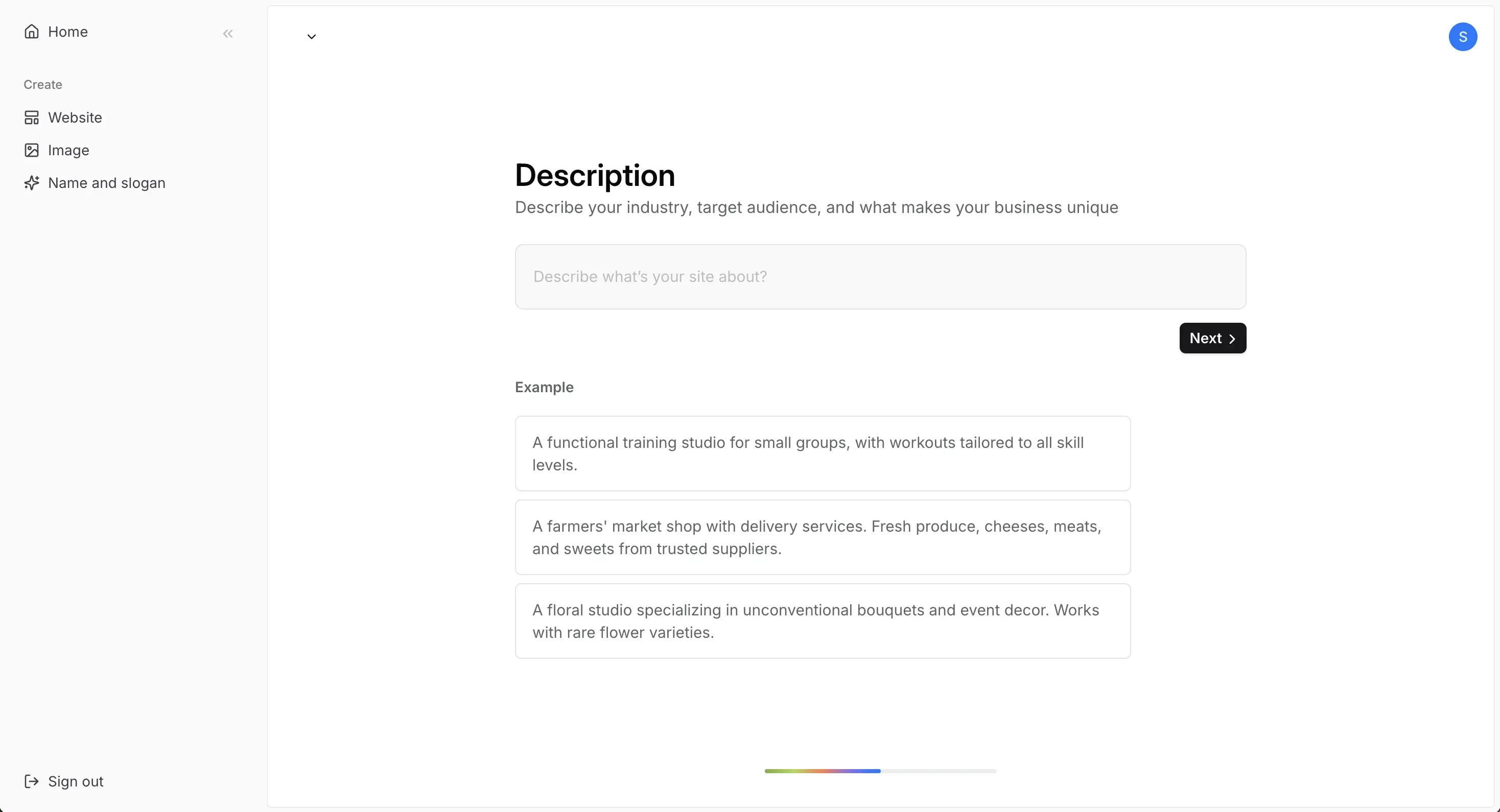
Both Webflow and Framer require manual site construction, even with their AI assistance and templates. Codesi takes a different approach, generating complete websites from text descriptions in minutes and eliminating the builder interface.
You only need to describe your website requirements in plain language, and Codesi creates the full site, including structure, content, images, and branding. The AI handles design decisions automatically while you maintain control through visual editing after generation.
What makes Codesi different:
- Complete site generation in under three minutes: Describe your business or project in one prompt and receive a finished website with structure, copy, images, and contact sections ready to edit.
- Built-in AI logo and image creation: Generate custom brand logos and visuals that match your website’s tone without separate design tools or stock photo subscriptions.
- Instant publishing with free hosting: Publish directly to a free Codesi subdomain, or connect a custom domain with included SSL certificates and hosting.
- Visual editing after generation: Modify fonts, colors, layouts, and content through a simple interface without coding or learning design systems.
- No builder learning curve required: Skip hours of training investments needed for Webflow or Framer.
Website builders work well for teams running ongoing design operations. Codesi is better suited to business owners who need professional websites without having to learn complex platforms or manage multiple tools.
Ready to launch your site faster than traditional builders allow?
Try Codesi for free and generate your first website in minutes.
Create your website with AI today
Codesi is a platform where you can make a website in 3 minutes.
No coding, no designers, no hassle - just AI.