Back to blog
10 Best Website Example Ideas for Inspiration in 2026
Explore the best website ideas to inspire clean designs that engage visitors and help you create a site that feels polished and built to convert.

Nov 28 2025

Generic website templates and outdated galleries won’t help you build something that converts. Google’s data shows that sites that take over three seconds to load lose 53% of mobile visitors, and 88% of website users would not return to a site after a bad experience.
This means poor sites frustrate users and lose more than half of them before the content even appears.
To help you avoid building a site that users won't care about, we’ve compiled ten website example ideas for inspiration. Each includes elements you can apply to your site based on your needs.
Key Takeaways
- Good design supports content, not the other way around
Visuals, spacing, and flow should make your message easier to understand, not compete with it. When design and copy work together, people stay longer on your site.
- Focused pages with single actions convert better
Pages built around one clear call to action outperform cluttered designs with multiple competing choices.
- Clean layouts with strong typography beat decorative graphics
Sites like Codesi and Stratechery prove that intentional spacing and readable fonts work better than busy visuals.
- Trust signals above the fold drive conversions for service businesses
Displaying verifiable metrics and social proof immediately builds credibility before visitors read service descriptions.
- Codesi builds conversion-focused sites using these proven patterns
Describe your business, and get a complete site with structure, copy, images, and branding based on what actually converts.
What Makes a Good Website in 2026
A good website is built around how people browse. Design trends have shifted from flashy animations to experiences that strike a balance between personality and usability. Visitors expect pages that load instantly, guide them effortlessly, and feel tailored to their intent.
Here’s what defines standout websites:
- Speed and performance: Fast-loading pages keep visitors engaged and create a smooth, reliable browsing experience.
- Mobile-friendly layouts: Over 60% of global traffic comes from phones, which means your site should function without requiring users to pinch, zoom, or scroll horizontally.
- Accessible design: Sites that meet basic accessibility standards capture more potential customers than sites that ignore these guidelines. Color contrast, keyboard navigation, and screen reader support determine who can actually use what you built.
- Strong opening copy: Visitors form their first impression in under a second. The opening text needs to explain what you offer and why the reader should care.
- Smart structure: Where you place forms, trust indicators, and navigation menus changes how visitors behave. Forms positioned above the fold get more submissions. Trust signals near CTA buttons increase clicks.
10 Best Website Example Ideas to Inspire You
These 10 websites solve different problems: some sell products, others capture leads, and others build audiences. Notice how each one structures information and guides visitors toward a specific action.
1. Codesi

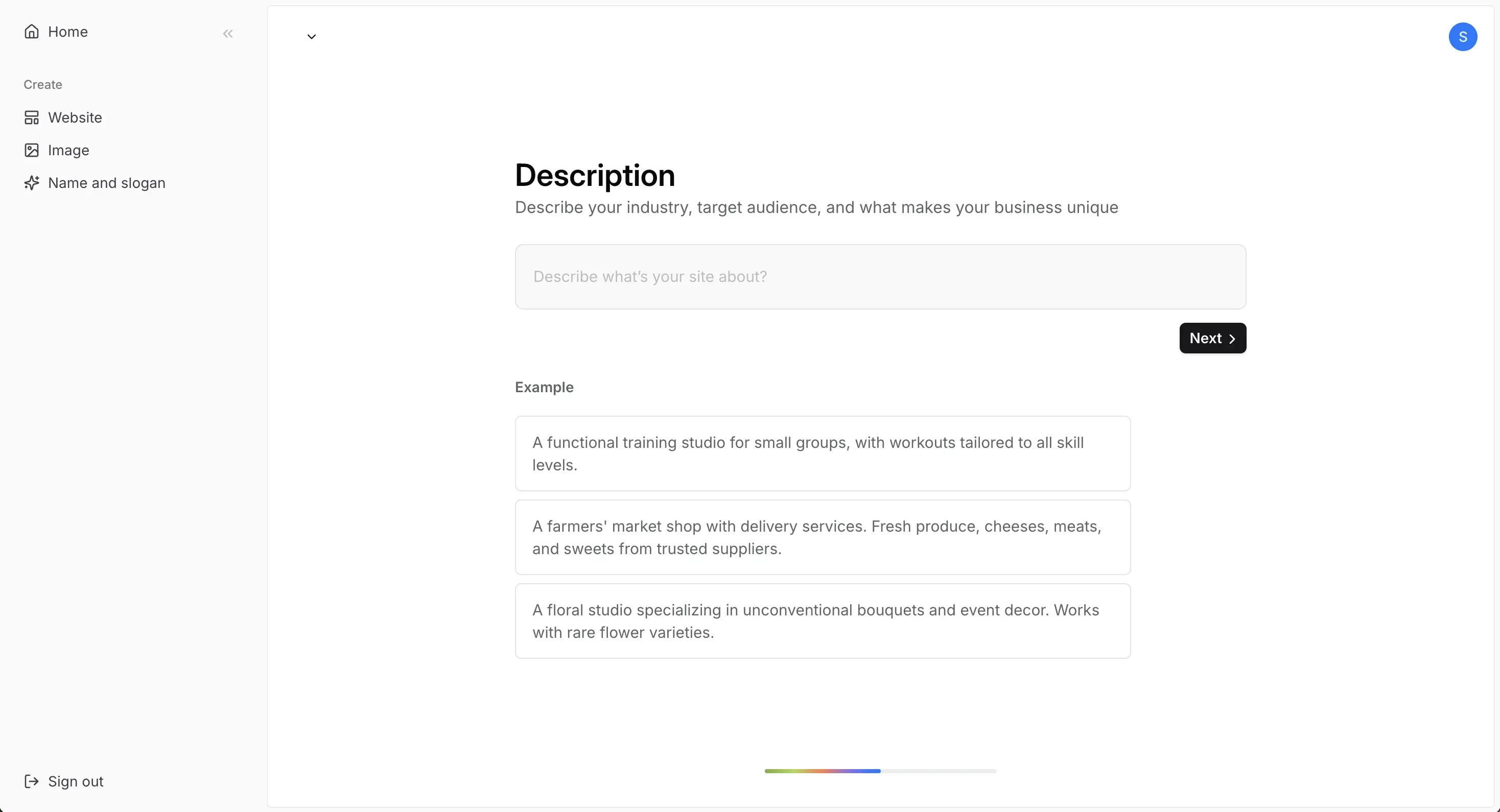
Codesi asks one question on its homepage: What is your site about? The system generates a complete one-page website in real time after you type your answer. The header displays only the logo until your site is finished.
The platform uses white backgrounds, black text, and one accent color throughout. Your generated site appears in a full-screen preview while editing tools sit in a collapsible sidebar.
What makes it work: Visitors experience the product immediately instead of reading feature lists, which builds trust faster than testimonials could. The minimal design proves that strong typography and spacing create professional results without decorative graphics.
Hint: Let your content breathe if your goal is clarity. A well-defined action often outperforms multiple competing options.
2. Apple

From the moment the Apple website loads, you’re met with striking visuals, spacious layouts, and smooth transitions that make the products feel tangible and accessible. It reminds us why less is more. Every section leads seamlessly into the next, almost like a guided story about design precision.
What makes it work: High-resolution photography, short yet purposeful copy, and consistent use of white space create a sense of elegance. Visitors don’t need explanations; they see the quality in motion.
Hint: Clarity and confidence are timeless. Keep your design minimal, let visuals do the heavy lifting, and trust your users to connect the dots.
3. Notion

Notion’s website shows how a digital product can feel personal. Instead of bombarding visitors with features, it invites exploration through clean visuals and gentle motion. The product demo plays directly on the homepage, giving potential users a clear glimpse into what they can create.
What makes it work: Subtle transitions, clear typography, and relatable copy reflect how Notion works. The scrolling feels fluid, leading users naturally toward signing up without feeling pressured to do so.
Hint: When your product empowers creativity, your website should echo that freedom. Let visuals lead, keep text supportive, and focus on demonstrating value instead of stating it.
4. Duolingo

Duolingo’s website radiates personality. Bright colors, friendly illustrations, and animated characters make language learning look like a game before users even sign up. The design combines playful visuals with a clear structure, making it feel fun without sacrificing usability.
What makes it work: Duolingo relies on gamification and simple design logic. Buttons are large, CTAs are clear, and the copy sounds human, not academic. The site encourages instant engagement by displaying progress bars and streak stats that invite action.
Hint: A sense of play can keep users motivated. Don’t be afraid to infuse personality into your layout as long as every visual reinforces the goal of helping users learn consistently.
5. Shopify

Shopify’s website is a masterclass in structured storytelling. It speaks directly to business owners at every level, from the curious beginner to the scaling entrepreneur. The design strikes a balance between credibility and approachability, utilizing concise testimonials, bold benefits, and crisp visuals that show real products in action.
What makes it work: The design avoids fluff, instead favoring real examples and straightforward explanations. Navigation feels logical, and conversion cues such as “Start for free” or “Enter your email” appear at the right points in the user journey.
Hint: Great design educates before it converts. When visitors understand your value early, the decision to act feels natural.
6. Linear

Smooth animations, smart spacing, and restrained color choices reflect the same discipline Linear’s software brings to project management. It is simple, yet every detail feels intentional. The site delivers calm precision from the first scroll.
What makes it work: The interface relies on alignment and rhythm. The copy is short, technical, and confident, showing that this product prioritizes focus over flash. Even the dark theme adds depth without distraction.
Hint: Design should reflect your product’s values. For brands built around structure and performance, quiet confidence leaves a stronger impression than loud visuals.
7. Pitch

Pitch’s website feels like a creative studio built for collaboration. Every section seamlessly blends storytelling with functionality, showing exactly how teams can turn ideas into polished presentations. Its design is energetic but never chaotic, using smooth gradients and interactive slides that bring the brand’s creativity to life.
What makes it work: Scroll-triggered animations, concise copy, and real-world examples help users understand the platform without needing a walkthrough.
Hint: Intentional movement can focus attention. Use motion and color to tell a story, not distract from it.
8. Figma

If any website strikes a balance between approachability and authority, it’s Figma’s. It welcomes both new designers and enterprise teams with sections that clearly outline what the product can do. Rather than relying on abstract visuals, Figma shows the tool in action, making collaboration tangible.
What makes it work: Clear value statements, recognizable brand logos, and screenshots of real projects show credibility. Every call to action feels personal, from “Try Figma for free” to “See how teams use it,” guiding different audiences naturally.
Hint: When your product appeals to multiple audiences, let structure guide each type of visitor toward their next step.
9. Miro

Miro’s website captures the essence of teamwork. Its dynamic design and collaborative visuals show how ideas evolve when people come together. The interface feels alive but remains easy to navigate, with floating elements and interactive boards that instantly explain the product’s purpose.
What makes it work: Clear sections for templates, case studies, and integrations make exploration effortless. Miro combines playful visuals with solid usability, ensuring even first-time visitors feel comfortable diving in.
Hint: Collaboration thrives when users understand the flow. Design your site to mimic the experience your product delivers.
10. Nike

Nike’s website brings brand storytelling to life. From the moment the page loads, high-quality videos, bold headlines, and clean product grids maintain a high level of energy. The design feels both premium and personal, inviting users to explore products through emotion rather than endless filters.
What makes it work: Consistent imagery, lifestyle-driven storytelling, and seamless transitions make the site feel cinematic. Each product is framed like a hero, supported by concise lines that speak to motivation and movement.
Hint: Emotions created by design, when backed by simplicity, can drive conversions as effectively as discounts.
Why Designers and Businesses Choose Codesi to Build Websites
Building a good website from scratch typically takes weeks to months and costs a lot. Teams go back and forth on copy, experiment with layout variations, fix issues on mobile, and work through multiple rounds of feedback before the site is ready. The cycle repeats until launch, often months after the initial idea.
Codesi removes that timeline and cost constraint entirely.
You describe your business or project in a few sentences. The platform analyzes what you wrote and automatically generates a website. The system builds a structured layout tailored to your goals and generates persuasive copy aligned with your description, so your site is both functional and ready to convert.
Codesi also creates a logo and color palette, and generates images that fit your industry and style. The generated site doesn't lock you into fixed templates—you can change any element immediately. The editing interface works without code, design software, or technical knowledge.
The platform also offers a free starting point; you receive three free website generations before providing payment information.
Here’s how to build your website with Codesi:
Step 1: Sign Up on Codesi
Start by creating a free account on Codesi. The dashboard is intuitive, so you’ll find everything you need within seconds.

Step 2: Describe Your Idea
Enter a short prompt that explains your goal. For example: “Create a clean portfolio website for a freelance designer that highlights case studies and client testimonials.”
Codesi uses this to generate a layout and structure tailored to your niche.

Step 3: Choose Your Layout and Style
Select a design theme that matches your brand. You can pick from layouts for business websites, portfolios, blogs, or landing pages. Each one is mobile-optimized and built for conversions.

Step 4: Generate and Customize
Codesi builds a full website with sections for hero banners, benefits, testimonials, CTAs, and visuals. You can edit any block with ease using drag-and-drop. Replace text, upload images, change colors, or reorder sections to fit your tone.

Step 5: Preview and Publish
Once you’re happy with your design, preview it across devices. Then publish directly or connect a custom domain. The site is automatically optimized for SEO, speed, and accessibility.
Are you ready to launch your website?
Sign up for Codesi today to generate your complete website in three minutes.
Create your website with AI today
Codesi is a platform where you can make a website in 3 minutes.
No coding, no designers, no hassle - just AI.